PICNIC07: Identity 2.0, Dick Hardt
September 28, 2007 | CommentsPICNIC07: Identity 2.0, Dick Hardt
Identity is difficult to describe: blind men and elephants. Contrasts German wikipedia entry for "identity" to UK and Dutch ones. Characteristics by which an individual is identifiable, either of herself or as part of her social group.
Lets you separate one person from a group of people; or it's a bunch of different personas. It lets you predict behaviour based on roles: prior knowledge kicks in when you see someone in a uniform, say.
How is it conveyed? Verbally, requiring trust. Official papers enabling trust on a local scale. Modern identity based around photo ID (passports etc).
Where is it used? ID transactions: party identification (who is this?), authorisation, profile exchange (telling something about yourself). Photo ID reduced friction. There's a lot of privacy (DVLA don't interact with a store I might use my driving license as age ID in).
Attributes of identity.
Identity 1.0 is all about records.
Verified digital identity is not what you give to the site, it's what the site builds up about you (e.g. ebay trading history): you can't carry it around with you.
Identity 2.0: a new architecture for this, elements of which are being used during the Olympics. Simple and open wins. Today, identity is closed, complex and stored in silos by individual sites.
2017: broadband everywhere, cheap storage, more use of electronic storage, mobile, device convergence, digital natives. Minimal passwords, rich portable profiles, portable credentials, rich attributes to share with sites, reputation services, proving you're human (to avoid CAPTCHA),
See also here
PICNIC07: Fabien Girardin
September 28, 2007 | Comments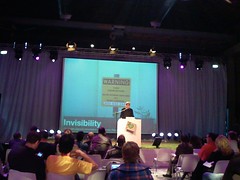 PICNIC07: Fabien Girardin
Some challenges of ubicomp:
- Invisibility: things may not be immediately apparent and will need signposting.
- Heterogenity: things need to work together seamlessly.
- Ownership: users of infrastructure don't own it.
- Cultural bias: designers add their own bias to designs.
- Decay: what do we do with old or decommissioned sensors?
One response to these challenges is playfulness:
- Seamfulness: deliberately exposing the existence of ubicomp sensors, say - e.g. by exposing the range of CCTV cameras to ensure people know where they're being watched.
- Ambiguity to draw attention or provoke questions about how people experience the environment;
- Learning from accidents, not just positive perspectives. Better can be worse sometimes.
Conclusion:
- Technological messiness shouldn't be ignored
- Little works has been done on this
- We should understand how malfunctions can be communicated
See also the talk Fabien did at LIFT07
PICNIC07: Dennis Crowley
September 28, 2007 | CommentsPICNIC07: Dennis Crowley
Used to work on Dodgeball, now looking at how people experience urban spaces. Sounds like a micro-dopplr: once your friends are aware of your location, it encourages interactions.
Now works at Area/code. As devices and people become location-aware, they're using this data for playful purposes.
Plundr: why should games be restricted to a board? Why can't monopoly be played across Manhatten? Plundr uses wi-fi positioning and creates a commodity trading game around it. Islands are superimposed onto a real-world map by the game, and players collect items from islands to sell them on other ones. It's a bit like a location-aware dopewars, where you need to physically move.
(Wonder what, exactly, he means by "wi-fi positioning")
Done a game for the Sopranos; a game you play whilst you're watching the broadcast. Each element on the game board appears in the TV show, and the aim of the game is to position the elements on the game screen such that as many as possible are in the programme at the same time: betting that characters appear together. All synced up with the broadcast.
Shark Runners: they partnered with marine biologists, tagged real sharks, and used the movement data of these sharks in the real world game, played out in real time. It's not be played in a short setting, it's a long-term, in-the-background game.
(Is there a term for these games which involve infrequent interactions, but play out constantly?)
Dennis shows Pacmanhattan, obviously. Crossroads is a game where you capture street intersections from other players.
One for the Locomatrix crowd :)
links for 2007-09-28
September 28, 2007 | Comments-
"Anyone with an idea for useful software can submit it on the site. Others who like it can then pledge money to help see the vision realized. Developers browsing the site can submit quotes for creating the software"
-
"Vodafone now passes through automatically any domain starting with "mobile."" - or wap., mobile., or ending .mobi. A step in the right direction.
-
"Frankly, the main reason I had to start this company was to have fun at work. "
-
"Someone call me when they've figured out how to put an 20 inch XVGA screen in the palm of my hand. What a fucking dumb-ass criticism." I've missed Russ :)
-
"Netsize is pleased to announce the launch of its information database module « mDevices »... a knowledge database on mobile handsets technical features and functionalities accessible... via an API/Web service." Interesting, anyone got more details?
Amazon Mechanical Turk and international access?
September 28, 2007 | CommentsI received this email from Amazon a week or so back:
You are receiving this email because you registered with Amazon Mechanical Turk as a Requester with an address outside of the United States. We regret to inform you that Amazon Mechanical Turk will no longer support international Requester accounts starting October 1, 2007. On this date your Requester account will be closed.
A real shame, as we had a couple of interesting projects we were thinking might be a good fit with it over the last few months. But also a bit of a wake-up call: the lesson here is that unless a provider of APIs is going to commit to an SLA, or even their future availability, then it's probably foolish to rely on them. A semantic web of collaborating services is a lofty goal, but we'll still need commitments (probably underpinned by commercial relationships) to realise it.