PICNIC07: Designing Killer Experiences, Peter Frankfurt
September 27, 2007 | CommentsPICNIC07: Designing Killer Experiences, Peter Frankfurt
Every company in entertainment wants to be Pixar when they grow up. Started off with title sequence for Seven, attracted clients and young designers. Putting something onto a cinema screen is quite attractive for these folks :)
Started working on Transformers 1+ year before the film came out. Teaser created with no footage of the film. Michael Bay saw it: "Fucking cool". Shows different versions of the trailer for different markets, with logotype transforming into various scripts. Doing 20+ versions was financially pretty good for a graphics company ;)
Amusing trailer for Spike TV - like 24hrs of Bravo TV squeezed into 15 seconds with volume and contrast up to maximum.
Very visual presentation, difficult to get notes done...
Building virtual worlds is about taking something familiar and doing something to it that upsets, delights, whatever - just gets your attention.
Talks about World Trade Centre redesign: the original proposals were deeply unpopular so it was put out to the design community. Small agencies worldwide got together. "We literally had to create a world in lower Manhattan in 6 weeks". Decided to treat the presentation and process of the design as a film-making process: storyboarding informed a lot of the design, and a film was created as part of the presentation.
PICNIC07: Andrew Keen, author of Cult of the Amateur
September 27, 2007 | CommentsPICNIC07: Andrew Keen, author of Cult of the Amateur
This is in response to David Weinberger's earlier talk.
Andrew: David is a philosopher and marketer; his talk was a philosopher selling the web in a seductive way. I don't agree with a lot of what he said. The issue we disagree with on complexity; he says "we want more complexity; complexity is interesting".
He's mixing media with the world; what he wants is for media to reflect the world, but I don't think it should. Media shouldn't trivialise the world, but communicate it in a way we all understand; the Internet today doesn't do this, it creates complexity and confusion. The job of gatekeepers in traditional media is to simplify things. Do you think media should reflect the world?
Talent is scarce, as are resources. Good journalists have both the ability to do their job, and the ability to devote their time to it. Amateurs don't have this.
[...trailed into an interesting, but difficult-to-blog, argument...]
links for 2007-09-27
September 27, 2007 | Comments-
Whoops. "In the meantime, please use email to share photos with your friends," the company said.
PICNIC07: Panel, \"Up Close and Personal: Share your Life\"
September 26, 2007 | CommentsPICNIC07: Panel, "Up Close and Personal: Share your Life"
First up, Jyri of Jaiku with his personal take; references Brad Fitzpatrick on "the Social Graph" (posh name for social software, it seems). People are connected by objects, and we need to represent these objects somehow: e.g. delicious turns bookmarks into social objects, used to connect me to other people who've bookmarked the same places. Flickr turned photos into social objects, Youtube videos. We're going into activity streams that show what your friends are doing now with objects. Subject-verb-object. Social software promotes what I should be aware of around myself, in a virtual social space. Will we see a "facerank" algorithm analogous to "pagerank", and delivering similar benefits.
 Biz Stone on how Twitter started: Jack and he were working together, wanted to tie SMS and the web together and were intrigued about MSN status messages. Built a prototype in a couple of weeks, which was really fun to use. Twitter's being used for social activism: "censorship is the sincerest form of flattery". Example of an activist leaving micro-updates: dead easy, and even the lack of updates is in itself an indication of useful information.
Matt Biddulph of Dopplr: Dopplr users have so far travelled 89 million miles. There's serendipity in travel. (Dopplr==planned serendipity?). This gives some access to the things high-end travellers have: e.g. help from others.
Raymond Spanjard of HYves talks about how it put him in touch with transexuals seeking wigs :)
Jyri: "When your friends know what you're up to, you get magical powers".
Raymond: "the future of social networks is mobile".
Felix Petersen, Plazes: most people don't use social networks to hook up with strangers, but to keep track of existing friends in different contexts. There'll always be a need for one-to-one communication, but discovery and finding out what your best option is for social interaction precedes that.
Biz: putting APIs atop of SMS and the like is empowering for the third world.
Talking about how each panelists network interoperates with other networks: "why are you witholding happiness from each of us?"
Jyri: lots of services don't share social networks, because we haven't had the means to do it. It's not due to lack of will; we're getting to a phase of Web 2.0 where we're coming up with useful standards: OpenID, XMPP to push out information (instead of pulling RSS). Jaiku lets you pull your updates from other services by RSS.
Biz: we created an API early on. We see 20x traffic via API than via web site.
Raymond: blah blah integrate flickr photos blah.
Felix: flannels, I feel :)
Matt: Dopplr are specialist, some people say that it feels like a feature of a larger system. We say "yes, the Internet". Dopplr works best with other systems: "what did I twitter from SF"? Dopplr should appear amongst other services, you should never need to go to the site. We've launched Facebook, import social graph from twitter, and the ability to dump data out from the API, not just get it in. Dopplr is fun and interesting (and has no memory until 1.0), but may get mixed with other sites.
Moderator invites the panel to ask each other difficult questions.
Jyri: Biz, will Twitter ever support photos?
Biz: Not sure, we're not against the idea but love the simple 140-char format. Possibly but there's no timetable.
Matt: Jyri: do you regret starting out making mobile clients?
Jyri: no. Platform plays are easier as it avoids the problem of distribution. Will mobile be ready for rich applications, or will we be stuck with SMS? We'll probably have pockets of more advanced mobile devices (e.g. Nokias), operators have cut data rates, etc. But for global reach you're stuck with lowest common denominator like Twitter.
Jyri, Matt: how does doing a travel site square with the ecological impact of it?
Matt: serendipity allows people to optimise their trips. One problem with carbon offsetting programs out there at the moment is that they don't know where you've been - we do.
Moderator: one thing that struck we watching Twittervision is that it gives you the sense of everyone experiencing the same range of mundane and profound experiences and emotions.
PICNIC07: Jonathan Harris of We Feel Fine
September 26, 2007 | CommentsPICNIC07: Jonathan Harris of We Feel Fine
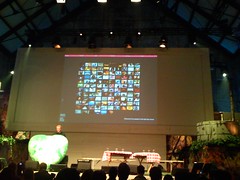 First movement: gathered sentiments from weblogs with an automated search, plots them onto a screen as moving dots, and implements clustering behaviour between them.
Second movement: gathered photos from these blog posts and mixes them with the sentiment.
Third movement: feeling breakdown of the overall population (most people feel "better" apparently). Also a gender breakdown (women slightly more prolific than men in blogging).
Fourth movement: plotting weather conditions at time-of-post and use this to implement behaviour of sentiments.
Fifth movement: statistical view.
Sixth movement: visualisation as gelatinous blobs.
Oodles of lovely data, categorised and related.
Passive observation leads to candid findings, because people don't know they're being watched.
New project, Universe: "is there a mythology we hold, as a species, today?" Is there a set of global stories affecting all our lives? Think about a new metaphor for organising information, beyond the web page - based on relationships.
A lot of his projects involve setting up simple rules, and running them over time (e.g. "gather all web pages including the phrase 'I feel'"). In Spring he subjected himself to the same sorts of rules his programmes follow - which led to The Whale Hunt. Jonathan decided to photograph the entire experience of living with an eskimo family hunting a whale at 5 minute intervals - even when sleeping (using a timer to take pictures). When exciting things happened he'd quicken the pace of photography, producing a sequence of images matching the pace of his heartbeat: 3214 pictures over 7 days.
Graphs excitement level over 7 day period, using intervals between photos to gauge excitement.
Also wanted to experiment with a new interface for human storytelling: taking an epic experience, documenting it, and looking for sub-stories. Filters on the photos let him whittle down pics by character, activity and themes.