LinkDump
May 07, 2011 | CommentsPost-holiday link-dump of things that made me go hmmm...
- Like stamps for the real world. If they release "sticks to poke people with" I will very likely buy one.
- The Natural Language Toolkit: "Open source Python modules, linguistic data and documentation for research and development in natural language processing and text analytics"
- Managing Your Own Psychology: "Ideally, the CEO will be urgent yet not insane"
- Fast Path to a Great UX - Increased Exposure Hours: "Exposure hours. The number of hours each team member is exposed directly to real users interacting with the team's designs or the team's competitor's designs. There is a direct correlation between this exposure and the improvements we see in the designs that team produces."
- Patterns in Functional Programming, a blog/book-in-progress about functional concepts. On the tech side of things, this is interesting me at the moment... or more accurately, a few developments internally at FP and the launch of Functional Brighton might kick me into learning Clojure, something I've meant to do for a couple of years now.
- The cost of being first, another excellent post from The Ad Contrarian (one of my favourite blogs, a beautiful little diamond): "While everyone wants to say they are at the “leading edge” of digital media technology, it seems to me that there is little or no advantage to it. In fact, with so many new advertising and marketing technologies evolving, there may be a greater potential risk than reward in being at the leading edge."
- Working with the Chaos Monkey, a tale of systems components deliberately set up to fail in order to test overall system resilience.
- Stewart Lee on content: "A few years ago, I received an unsolicited e-mail asking me if I was interested in “submitting content”. I was confused. The sender explained that I was a “content provider”. Did I want to provide content?". Also "I am a curator. What a dead word. It sounds like someone stirring turds in a toilet bowl with a stick".
- Pepsi Introduces "Social" Vending Machines: "I had never thought of a vending machine as anything other than a pay-refrigerator. Apparently to these people it is some form of mystical deity"
Topical android games
April 20, 2011 | CommentsA hat-trick of posts today. This one's something I've wanted to do for ages; it was something we fancied trying out under the Fat Parrot brand, but have never quite gotten to. I alluded to it in my post about Fat Parrot, but here's a bit more detail.
The Android marketplace has no approval, and lets you launch games within minutes. One of the things I remember from my computing teacher at secondary school was a quote he was fond of: "bigger problems don't mean bigger solutions, they mean different solutions". Scale brings differences in approach. Big O Notation and all that.
So Android's lack of approval doesn't just let you do stuff faster than Apple and Nokia will allow you to, it opens up completely new opportunities. Then consider Wieden & Kennedy doing that lovely reactive Old Spice stuff on Twitter: you can streamline production of even high-quality content and do it "live".
So imagine taking 5-7 different game formats: sliding tiles, puzzles, "catch a falling object", etc. - and being able and ready to reskin them in response to a news story, every day - and publish them, there and then. So that by 8am you have a few games in the marketplace which are simple enough for anyone to understand, and tied - perhaps amusingly - into something that's only just happened.
My gut is that this would let you see more sales from the effort you put into writing one of these games; that occasionally some of these games would go or be driven viral, and generate disproportionate returns; that the scarcity of deleting old games might even encourage downloads or sales; and that you'd have something which could scale across territories. You'd also get a chance to iterate daily (something few business do right now), learn what works and what doesn't, and get better, day in, day out.
6 game formats, daily launches, earning £50 each day in 5 territories doesn't feel unachievable and is about half a million a year in revenue.
Maybe one day...
Stealth UI from Google and Microsoft
April 19, 2011 | CommentsLike lots of people, I've been oohing and aahing over the PhotoSynth app Microsoft have just given away for the iPhone. It's clever, useful, striking... and oh look: it seems to coincidentally carry with it a taste of the distinctive Metro UI Microsoft are using throughout WP7. Look at the typography, spacing and button/link styles:
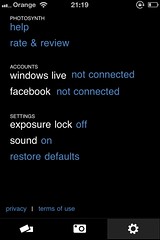
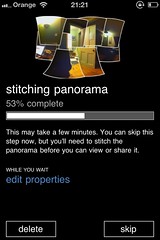
Now, isn't that interesting? Because it was only a couple of weeks ago that I looked over the Google Mobile App and was struck by its use of Android metaphors: in particular, the drawer which is dragged down from the top of the screen, much like the Android notification bar:
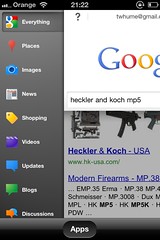

2 examples: That's a big enough sample size to justify a blog post!
Here's what I think is going on here: mobile hardware is commoditised. A majority percentage of new smartphones are lumps of metal with a front-face of touchable glass, and maybe a button or four. I'll bet you that, with a few exceptions, most purchasers of mobile devices aren't influenced by hardware differences - and that it's software which wins them over or loses them. Software is where differentiation is happening nowadays.
And here come Microsoft and Google, taking elements of the UI from their own mobile operating systems and deploying it into free apps for iPhone; giving iPhone owners a taste of what they're missing.
One explanation: G and MS (understandably) take the stance that the UI they have designed for their own devices is the best one they could think of, and that it's only natural for them to use its principles elsewhere. Sounds reasonable, especially if you consider the benefits the UI brings to outweigh the cost of having to learn something "slightly different".
But I think there's another reason to do this: that it's a great way to reach iPhone owners and show them that there *is* an alternative to what they know and love, to acclimatise them to a different way of doing things, and maybe, just maybe, show them that they can have a good experience on devices that aren't designed in Cupertino...
Common lies of social software
April 19, 2011 | Comments I've been thinking about this for a little while, spurred on by a combination of The Real Life Social Network (an excellent slideshow from a Googler) and going to see Robin Dunbar talk at the Ropetackle Centre back in February.
Dunbar was fun. Some highlights from my notes (which I forgot to post here at the time):
- Dunbar's number pops up everywhere: early hunter/gatherer clans were 150. Average village size in the Doomsday book was 150 (except in Kent, where it was 100). Hutterites split communities when they hit 150, because that's the point where they think you start needing a police force - and they want to avoid hierarchies;
- Urbanisation prevents coherent social communities: your 150 are scattered and you end up with isolated groups of friends, places to hide yourself from the unblinking gaze of your 150 - which leads to mischief;
- Lifelong monogamous relationships require computational brainpower: larger brained birds tend to be lifelong pair-bonders; the next biggest are annual pair bonders. This is driven by the need for bi-parental care: they need to coordinate to do it well;
- Primates have usefully generalised this pair-bonding to create friendships. They developed the skill of modelling the mental processes of others to help with this;
- Friendships deteriorate over time fast, without investment in them. By contrast, kinship deepens over time;
- Those from large extended families have fewer friends: your 150 gets filled kin-first;
- Military structures conform to Dunbar numbers: a section of 15 men, a platoon of 35-50, a company of 150, a battalion of 350. The seriousness of military endeavour means it's important to get coordination right. The company is the primary unit of loyalty in the military; most competitive sports are between companies;
I've been mentally collecting "lies of social software" since then, if that doesn't sound too melodramatic. So far I've come up with these, mainly based on my experiences with blogging, Flickr, Twitter and Facebook:
- "Your friends are equally important". Dunbar pointed out that we have concentric circles of friends: 5 close ones, 15 acquaintances, 50 rough friends, etc. Yet in my friends lists on Twitter and Facebook, everyone's equal (and usually alphabetical). I like what Path have done around limiting the size of your network, and the Flickr concept of Family, Friends and Contacts - but what about software for just you and those 5 of your closest? Or for you and your other half?
- "Your friends are arranged into discrete groups", with a corollary that these groups rarely change. Managing lists of friends is unpleasantly icky. I bet Google or Facebook could take away much of the pain of creating these lists by analysing my flow of communications. I bet they could notice and prompt me to confirm changes ("you're emailing Freda a lot at the moment - working late or is she a friend outside work nowadays?"). Perhaps the challenge is less technical and more how to present this to a privacy-concerned public;
- "You can manage hundreds of friends". Dunbar talked about Facebook offering circles of friends beyond the sizes our brains would naturally sustain, and mentioned that conventional friendships need sustaining interactions. I asked whether software might act as a friend-ship sustaining interaction in the absence of physical nearness - i.e. as a prosthetic primate-grooming tool. His suspicion was that without some physical contact even virtual friendships will fade, but virtual contact would slow this degradation. Conversely, in the real world, friendships don't last forever: why do we insist that they do in the virtual world? I don't know of any social network that times them out in the absence of contact;
- "Friendship is reciprocal and equal". Some people are more important to me than I am to them, and vice versa; we might not like to face up to this in every day life but it's true nonetheless, and our digital tools don't reflect this. More than that, commuting relationships into binary leaves them unhelpfully stark: what room for plausible deniability in a world built on flippable but certain bits?
I think that if we're going to use software for social purposes in future (that is, to mediate, extend or substitute our social relationships), we'll need to start fixing some of these bugs in the current implementation. I'm having some fun thinking about playful ways this might be done...
Kindling
March 24, 2011 | CommentsThings I love about my Kindle:
- Its weaknesses feel like strengths. The web browser is rubbish. It's comforting to have one there for emergencies, but I've hardly ever used it;
- The cheapo leather case. It feels like one of the books my dad would use for display in his shop. The kindle is a well-loved, treasured item;
- No multitasking - yay! No multitasking means fewer distractions means more reading;
- One-click ordering, frictionless flow of financibits between my pocket and Mr Bezos;
- The unboxing experience was a glorious slap in the face to Cupertino: recycled cardboard instead of glossy white; welcoming me by name instead of inviting into the Cupertino fan-club;
- Synchronisation between devices: reading a few pages on my phone updates my place on the Kindle.
Things I hate about my Kindle:
- The bizarrely WIMPy UI, completely unsuited to using with cursor keys. Who cares about windows and cursors? Why not use the left/right paging metaphor here?
- 90% of my keyboard use is typing numbers, to go to specific pages. Numbers are the hardest thing to type (I have to pop up the symbol keyboard);
- Organising large numbers of books and documents is icky. Collections are a start but a year in, I'm going to hate this aspect of it;
- Why not more use of book recommendations? Feed me more books and I'll buy them, this thing is addictive;
It's strange how warm I feel towards this device, shocking and pleasing at the same time. After my mobile phone, it's the first thing I carry with me: it's cheap enough for me to worry less about damage or theft, and I don't feel like I'm showing off if I get it out on the train (as I do with iPad).