Casuality Europe: Hype vs The Real Deal
February 08, 2006 | CommentsCasuality Europe: Hype vs The Real Deal
Joel Brodie, MD JoJu Games
Gabe Zichermann, Chief Marketing & Strategy Officer, Boonty Games
Michael Schutzler, SVP World Wide Games, RealNetworks
Mark Cottam, President MumboJumbo
Rugter Peters, CEO Zylom
Gamezebo: "The First Casual Game Review site". Launching tonight.
JB: Downloads: the business is stagnant, conversion rates at 1-2%
[ 3 votes for REAL, 1 for HYPE ]
MS: Microtransactions are more important than downloads. Real is getting out of the download business.
JB: Europe: the casual game download business grew up in the US and expanded beyond.
[ 4 votes for REAL ]
It's hard to call Europe a market; it's fragmented. Croatia won't be a top market for casual games, the UK will be.
MC: Most of our revenue comes from the retail market. It's hard to persuade retailers to sell casual games for $20.
MS: Gameplay doesn't travel very well across borders.
RP: The economics behind a game specifically for Norway just aren't there. Why design specific games for a specific market?
GZ: If TV was produced only in one market, it would be much more limited. The only possible place where territory-specific games can work is in the casual games market.
MC: Core game mechanic is the key thing, not localisation.
JB: Asian-style multiplayer games and microtransactions. 25% of the Korean population admit to having played a certain game.
[ 3 votes for HYPE, 1 for REAL ]
GZ: It's not going to happen in the US or the UK. People won't devote their energy to a multiplayer game.
MS: 120m online in the US, 40m in Korea. 25m Koreans are gamers. Why are there not 25m gamers in the US? What's interesting about these games - advanced avatars etc. - could come to the US and manifest itself differently.
MC: How will we do multiplayer games across portals?
MS: Some portals are more open than others... but there a number of ISPs and portals more interested in a good user experience than what plumbing is in the background.
MC: Portals don't want to see customers going to different portals.
[ Not sure how playing against someone on another portal equates to losing customers ]
MS: This begs for an open source API.
RP: Most user experience for downloaded games is single-player. The next phase in Europe/US will be about making multiplayer, but not necessarily MMO, games.
GZ: The Korean market operates in a very extreme way. What in Europe has suddenly gotten 30% of the population participating?
MS: No-one expected casual games to be interesting 10 years ago. Advanced multiplayer casual games will be big in the US in future. They won't be the same games as in Korea but they will express similar principles.
MC: This model would dramatically change the casual game industry: large publishers, large portals.
JB: XBox 360
MC: There's no reason to believe people won't play casual games on the Xbox 360. Consoles don't just appeal to the hardcore gamer.
[ Disagree: unless a console has some other usage besides games, I don't see how it'll get casual gamers to buy it ]
MC: Casual gaming is a lifestyle. No matter what device you use you should be able to play. We're going to see significant growth in this area.
RP: Of course there is an audience for casual games, but that doesn't mean that they'll shift to playing on an Xbox 360.
GZ: I can't see my grandmother sitting down with an Xbox 360.
MS: Microsoft is not interested in building a casual games platform. Xbox 360 is meant to be the media centre in the home. The focus is movies, music, etc. There'll be some people playing Bejewelled but mostly it'll be music.
GZ: The Xbox won't be responsible for a significant number of casual game plays.
MS: We're not arguing mobile.
MC: We don't have figures for revenues on Xbox Live.
Audience: casual games are about convenience. PCs have viruses etc.
MS: We're committed to the Xbox for the next 2 years. But will this be a big part of the casual game space? I don't know.
JB: Cross-platform gaming. Is this the holy grail of casual games: players on different platform participating in the same play? The technology doesn't work, no-one knows the revenue model, and there are form factor issues.
[ 2 votes for HYPE, 2 for REAL ]
GZ: The value is locked at the intersection of mobile and the PC.
MS: I want this to be true in the worst possible way. Has anyone tried the web-to-mobile experience? There are latency issues. What about device fragmentation - 300 different handsets, 11 languages, 50-70 carriers? That's lots of SKUs for one game.
MC: We've seen technology which takes the same product across many platforms. It depends on what kind of game: turn-based ones like darts work well and let us escape some of the technology issues. It won't come tomorrow but it will be part of the future.
RP: First multiplayer, then cross-platform. Multiplayer isn't really there yet.
JB: Retail. The only reason you got into casual games was to escape the disaster of retail. PC game sales are declining, margins shrinking and so on.
[ 3 votes for REAL, 1 for HYPE ]
MC: MumboJumbo is focused on bringing the best of content from download into retail. Casual titles outsell traditional games. We've yet to hit saturation at retail, it's absorbing as much content as we can bring.
MS: The number one selling game in Japan is "train your brain". Casual games will be a monster success on the DS.
MC: We're amazed at the places where we can sell casual games. We have a chain called Gamestop in the US: a very hardcore game audience. We think that mum and dad are taking their kid their to buy a $50 game and are buying themselves when they're there. The kind of consumer buying casual games is the kind of person who's shopping at retail outlets in Europe.
RP: I don't want our games to be in a computer shop, I want them in a clothes shop.
GZ: In 5 years time, will Yahoo Games be a top 5 retailer of games in the US as far as revenues go?
MS: No.
GZ: Will Real?
MS: No.
GZ: Walmart controls half the market in the US, everyone else divides up the rest.
MC: MumboJumbo is the 11th largest publisher of PC Software in N America. We'll need huge growth to get to be 8th.
JB: Developers. Are they an endangered species? The market is maturing into a hit-driven business. Can independent casual game developers survive?
[ 3 votes for HYPE, 1 for REAL ] : HYPE = casual games companies survive, REAL is they die.
JB: Clones: 3 x real, 1 x hype
JB: In-game advertising: 2 x real, 2 x hype
JB: Subscription services: 1 x hype, 3 x real
JB: China: 2 x real, 2 x hype
JB: Mobile: 4 x real
JB: Skill-based games: 3 x real, 1 x hype
JB: I'm a VC. What casual game company would you pitch me?
MC: Creating casual games is still an inexpensive business. The core mechanic is what's important. The right developer with a $1m budget could produce 8-10 games, one of which should be a hit.
GZ: Agree. Quality of content will become the most important issue over the next few years. There'll be a sea of clones and a handful of extraordinary titles.
RP: A company involved in delivering advertising to a CG audience in an effective manner.
MS: A DS developer
Q: What's the hot type of casual game this year?
MC: Not sure but it'll be on the Xbox 360 :)
GZ: More economic simulation games.
MC: An altered game mechanic. A clone won't be a big hit, most games are derivative.
RP: Lots of multiplayer games in the next 12 months.
Q: Microsofts angle with the XBox 360 is that porting from PC to xbox is easier than porting from PC to mobile.
JB: So, will MSs tools be tools for the casual game?
MS: At the end of the day, who's sitting in front of the Xbox 360?
MC: Pulling a game over to the 360 isn't the answer, you need to take advantage of the platform.
Casuality Europe: Impressions so far
February 08, 2006 | CommentsThere seems to be a strong US focus here, and - perhaps coincidentally - a broader use of the "casual game" term than what I'm used to. Certain console and PC titles seem to fall under this category, which surprises me as I can't really see how anything could be less casual than a gaming session sat at a screen. Suspect this may be due to wearing mobile-shaped blinkers for half a decade.
At other events I've been to, the tone has been a rather unrealistic "how do we get around those pesky operators". There seems to be a bit more realism here: "you may not like the operators but you don't have much of a choice but to work with them... today".
I've enjoyed all the talks I've been to so far. "Alternate business models for mobile" didn't really reveal any fantastic new models as such, but it was great to hear experiences from aggregators, developers, and media companies trying to get commercially successful in this area.
The event seems very developer-oriented.
Casual games on mobile: Why operators and publishers are excited to see more casual mobile content
February 08, 2006 | CommentsCasual games on mobile: Why operators and publishers are excited to see more casual mobile content
Gunnar Larsen, Director Mobile Games Europe, Real Networks
Alex Bubb, Jamdat
Bryan Trussel, Microsoft Casual Games
Tim Harrison, Head of Games Vodafone
First slide emphasises difficulty of fragmented value chain.
GL: What is a mobile casual game? Is it the same as a PC casual game?
TH: On mobile the fundamentals are similar to the PC. Being here today reminds him of mobile conferences a few years ago. Modes of play and discovery are different. The common ground is simplicity, approachability and fun. It's a less self-conscious form of gameplay: games as boredom-busters and to kill time, not for games' sake. The difference is the level of complexity in the mobile space. Operators see community as importantly as games publishers.
AB: Jamdat have one of the most successful puzzle titles. The demographic is huge: everyone has played Tetris, even people who don't consider themselves gamers.
BT: It's not coincidence that your top casual titles are the top titles on mobile. You need to be sensitive on mobile: it needs to be simple to learn, no tutorials. Mobile is about smaller timeslices
GL: PC is more about relaxation, mobile is a boredom-buster.
BT: You'll always go to your PC or Xbox to spend half an hour playing.
TH: We were surprised by the number of people playing mobile games at home, after research we did last year. Playing a console game involves an investment of time. There's lots of reasons to choose one platform over another.
AB: Dip in, dip out is important. But that might not be the entire game.
TH: Solitaire is the killer app on any platform. Tetris is big too.
AB: The discovery mechanism is very different on mobile.
GL: How big is the opportunity? We hear 1.5b game-enabled handsets.
TH: Mobile is one of the thinnest areas in terms of numbers. The majority of the market is controlled by notoriously cagey operators. Market estimates for mobile gaming range from 1.5bn - 4bn [ dollars or pounds? ]. But we've not scratched the surface yet. The discovery mechanism for games is a key reason why not. 65-80% of mobile owners have played a game on their phone (though the majority are playing an embedded game). Our challenge is converting these embedded players into downloading players. We're doing "free trial" games on handsets. Flash isn't a model we can imitate yet, with only 1% of our handsets Flash-enabled, but "try before you buy" works.
BT: There is money being made in mobile right now. Handsets are getting more capable - the potential audience is increasing. It's possible to get more efficiencies in the value chain.
GL: What are the challenges? What's the process for bringing a game to market?
AB: There is limited shelf space in the mobile market. A simple game is a good start. There are complexities you need to overcome: porting etc. Different handsets, chipsets, etc. But there are ways around this.
GL: What's your advice to a mobile developer with a great game?
TH: Talk to a good publisher, or an aggregator operating in direct-to-consumer. Mobile operators want value adds on top of a great game; they want a way to attract customers. You need a sustainable roadmap of high-quality product.
BT: It's not that carriers don't want games: there's just too many out there.
GL: How do you recommend that developers handle porting and fragmentation?
AB: Every publisher has their own strategy. The difference between a mobile and console publisher is a split between front-line and deployment production. We're scaling up in Romania etc to handle this.
BT: Mobile hasn't seen an abstraction layer for different hardware. Why isn't there such an abstraction layer?
TH: This is the price we pay for the ubiquity of mobile, unfortunately. So much creative energy and revenue goes into back-end, not game creation and marketing. There will be consolidation of operating systems to a certain extent. It's like the home computer market in the 80s. We're moving out of that phase into the early-PC type phase. Mobile is still a few years away from this consolidation.
GL: How important is it for Vodafone to support 300 handsets? Can they get away with fewer?
TH: Vodafone Live is our proposition. We don't sell it as devices. All our dreams have been built upon the ubiquity of the device.
AB: For casual games, porting is easier. The lifecycle of products seems to be longer too.
BT: The easy games to write and port are the ones with a longer shelf life.
TH: Naming is important. Words like "racing", "action" or "puzzle" in a game title are a great benefit towards driving sales from an operator portal.
GL: What business models are suitable for mobile? Today it's pay-per-download. Is subscription a valid business model?
AB: Ultimately yes. It's not Jamdats focus now but long-term it has to be the way forward.
GL: How can we give people a better feel for the game before they spend their money?
BT: It's very important. The casual game on the PC is successful because you know what you're getting into. Mobile doesn't have the depth of recognition. Mobile users don't have a trust relationship with the game deck right now. Until we have trust, we'll have wary consumers.
TH: We're looking at game trailers in video to give a feel for the game.
GL: Is the pricing OK? A game in the UK cost £4.50, £5
TH: We think it's right at the moment but many customers don't perceive it as good value.
GL: Brian, do you see the web-to-mobile opportunity as interesting?
BT: There's a brilliant opportunity there. Someone who's just played the game on the web is the ideal customer to buy on mobile: they're pre-qualified.
GL: Is direct-to-consumer a threat to your business?
TH: No, at the end of the day the carriers are still making money. In many markets it's a bigger opportunity for carriers than the portal business.
BT: You come into mobile and see all the problems, then difficulties downloading games make sense. It's healthy to ignore the complications that are involved in doing this if we want to look towards a more pleasant future.
Q: Is Vodafone looking at exploiting advertising opportunities for casual and other kinds of gaming?
TH: Top of my wishlist for mobile is the equivalent of "viral flash games". From a monetary point of view it's harder.
Q: When will standardisation occur? When will games become valuable enough to have standardisation pushed?
TH: Mobile has been driven by open, not proprietary, standardisation. Open standards get implemented in different ways on different handsets. All that will happen will be market forces: a more consistent version of Java across devices is good for everyone.
Q: How will shortage of deck space change in future?
TH: the growth of off-portal brings more storefronts. Some folks will target specific handsets - not operators, but other guys. Faster handset and 3G allow sophistication of portals.
AB: Improved search will help.
TH: MMS discovery too.
Q: 3D, connected multiplayer games, cross-platform games: hype or reality
3D: 2x real, 1 x hype
Connected multiplayer: 2 x hype, 1 x real
Cross-platform: 3 x real
Casuality Europe: Alternative business models for Europe
February 07, 2006 | CommentsAlternative business models for Europe
Julie Pitt, General Manager, RealArcade
Riccardo Zacconi, CEO MidasPlayer
Eric Bethke, CEO GoPets
Kai Bolik, CEO GameDuell
Mathieu Nouzareth, President Boonty
JP: Try-before-you-buy games really picked up after the crash. Real Networks had to convince GameHouse to build a downloadable game. In Asia this model doesn't work so well (perhaps thanks to lack of protection for IP). 2% of games downloaders make a purchase; so most folks aren't spending money for content.
MN: Advertisers are willing to spend lots of money online. They need good products to help them do this. CPM for banners are too low. Rich Media advertising might be an answer. In-game advertising might be an answer.
[ Yuck - are we as an industry really fixated on banner advertising - still? How do production costs for a rich media advert stack up - presumably they're much higher? In-game ads sound more interesting, and you can see a precedent for it with product placement in films - it's familiar, perhaps. ]
MN: A 20mb game with a 2% conversion rate means you're shifting 2GB of data for each 2 sales - that cuts into margins.
JP: Most advertising has been around online games. What about in-game advertising?
MN: Perhaps this is more acceptable in the US which is more accepting of advertising.
KB: When we founded in 2003, games were popular. We wanted to monetise free players and do so by letting them pay small amounts at a time: they place a bet etc. So they're not paying for game content at all.
RZ: We have a 2-step process: at the first step he plays for free, up to 10 times. After that he's asked to upgrade to a paid account: £10, $10, 10 zloty. Once he is paid up, to compete against others he has to take small amounts from his deposit.
[ So it's either advertising-supported or gambling games, thus far. ]
RZ: Our experience is that many factors are at play here: the maturity of the market (how old your players are), say. We offer more than 37 payment systems: different ones for different markets. e.g. in the US credit cards work well, in the UK they're alright, in Germany they don't work that well.
EB: We think that advertising is extremely important. We're cautious about it. Gopets have a tool to let you design clothing for your pets so product placement seems quite natural. This is more exciting for advertisers than banner ads say. Companies like Massive are acting as a bridge between developers and advertisers. There is no equivalent of Massive in the UK yet.
[ So... specialist media buyers for the games industry then. Seems sensible. ]
JP: Massive focus more on the hardcore traditional gaming. They've not really looked at casual gaming much.
[ But this seems to be a theme here: lots of folks from the traditional gaming industry see casual as a new market for them, rather than a new sort of activity. And given that the models, the content, and the audience are all rather different... does this hold? ]
EB: Massive came to us to sign a deal. But they don't have any salespeople selling to women. I could put together Gap Jeans for the pets, but it's difficult without such a salesforce.
JP: It's not necessarily about the play, it's about the things you can add to the play and monetise.
EB: In Korea they had only games with subscription models for some time. Everything else collapsed - retail etc. Then came price competition, and free MMOs. The intention was to build volume then start charging - but users kept switching between games to avoid paying up. Then the "death model" was tried out: paying for new lives, selling accessories, etc. This was quite popular because it kept the perception of "freeness" in the games, but still provided for revenue. Players ended up spending more than they played for the subscription model.
MN: Mixing casual and MMOs is a new idea. Until recently MMOs are for serious gamers and casual games for everyone else.
EB: Western perception is "oh yeah, Korea are just nuts".
RZ: We've launched a sophisticated community. 80% of our users set up an avatar, 25% have bought additional items for their avatar. From surveys, we know that users like this - it's about showing off, it's not just about money.
EB: There was a phase in Korea when everyone had avatars you dress up. That lasted about 9 months before players noticed it had no effect on gameplay. Temporary gameplay-affecting items are the ones which make the most money. Gopets make $30 pcm from their paying users.
RZ: Lipstick, winning modes and losing modes are the biggest sellers.
EB: We have our own virtual currency, which has different exchange rates in different territories depending on friction costs accrued by working with different payment mechanisms. Our top selling item is a virtual rock for our virtual zen garden.
EB: Games have to be designed from the ground up for a given business model. Taking a subscription game and moving it over doesn't work that well. In the West we don't like these models because they seem unfair: but it's just like real life!
[ Maybe this is because we look to games for escapism? ]
Q: You're selling perishable goods. The rock can be used only once and resold. Are you looking to enable a marketplace and let players create and sell their own items?
EB: The initial approach is to make items non-transferable and perishable. This works for a little bit if you're the first mover. CyWorld (?) in Korea had a model where you rented skins for your site, which worked at first but then started losing players. Permanent items should be permanent. If they paid for something from you, they've bought it, and should be able to sell it. Don't be arrogant and insist they buy only from you.
Q: Who are your customers?
EB: Women in their teens and 25-45. Most revenue comes from the latter but the user-base is split.
JP: Other than avatars, how can we monetise community?
MN: Subscriptions? With a low price-point, yep.
RZ: We're monetising what is basically an online community. We don't want users to go away; with our model, we make money from plays so we need to keep them in.
EB: You can make subscriptions work with the item model. We have a limited-edition item which is only available to premium subscribers. This item normally has more game value and tends to resell for $25-35 each time too - so the player sees values. But the item-selling model came first, not subscriptions.
KB: Subscriptions fit well with any long-term proposition; anything which players think they'll need for a long time. Subscriptions need to have unique or exclusive elements to be successful.
JP: Do you price games lower in Italy and Spain (where the market demands lower pricing)
MN: On a case-by-case basis, yes. 25-30% lower.
EB: We price v differently between different territories (China, Philippines, etc.). How do players react to this?
MN: They don't tend to know. Players don't tend to go into price comparison services.
[ All this despite the single currency across Europe! I wonder how long this blindness to price variations will continue. ]
JP: How likely is it that the model will change completely? e.g. ISPs pay for content and bundle with access, as in the RealNetworks/Comcast music product bundle.
MN: This is taking over very quickly in Europe now. If you buy large quantities of games in advance you can do so very cheaply - e.g. 10% of retail. ISPs are fighting hard to acquire and retain customers. We've worked with ISPs giving away free music, games and videos. Games are more effective than music or videos when given away for free.
EB: Some carriers will pay for exclusivity on mobile games.
JP: Where is this going to go in the future?
MN: We've not mentioned loyalty schemes (frequent flyer miles etc.).
JP: People could pay for game content via these existing schemes?
MN: We're doing this in Korea. Companies have such an inventory of this virtual currency that they need ways to get it spent!
KB: Skill gaming is a perfect example of this: a points-burner.
[ Is skill-gaming a euphemism for gambling these days? ]
EB: The item business model is the most efficient I know of: players get to spend what they want to spend. This will happen to every market. The idea that you pay a fixed price for your content will die: we don't do this almost anywhere else in our lives.
[ ? Aside from mobile tariffs, TV subscriptions, magazine subscriptions, etc. ]
Q: What about in-game advertising vs advergames?
MN: I've yet to see a good advergame.
EB: Advertisers want to advertise a product, not develop good games. If I had a product that women over 30 bought a lot of, I'd talk to PopCap.
Q: From the gamers POV, buying an item means more involvement. Isn't this the opposite of casual?
EB: In Korea they have a term "advanced casual games". They have play times of 5-20 minutes. e.g. "freestyle basketball".
Casuality Europe, Tuesday
February 07, 2006 | Comments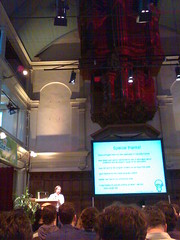
Jessica Tams welcomes everyone. "Casual games are easy to learn, but hard to master." Little upfront knowledge or skill needed. Can be played in a series of micro time slices potentially over a long time period. They're easy to acquire. They're platform agnostic.