Rewired State Hack Day
August 08, 2010 | Comments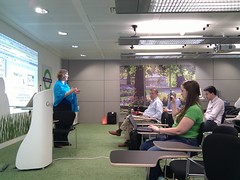 I spent yesterday camped out at the Googleplex in Victoria, taking part in a hack day Rewired State were running to support UK Online centres.
UK Online is an organisation with a straightforward remit: there are many practical and social benefits to being online, and there's a significant number of folks in the UK who never get these benefits - either because they've never made it online, or because they're net.illiterate. It's not just about lack of access: 10% of these people live in a household which has an internet connection.
The goal of the day was to improve and drive usage of the search facility which the UK Online site provides, letting visitors find their nearest centre, and to get the data underlying this search improved. Mr Thorpe and Sym Roe had prepared for the day by providing APIs onto the centre data, and this made a huge difference to our productivity: everyone was immediately able to poke around and start building on top of their great work.
I ended up working on a couple of things: making the search facility accessible by text message and by a telephone call.
In a team with Premasagar Rose, Daniel Morris, and Sym, we produced a mobile-accessible version of the search facility: text in your postcode to a shortcode and get some info back on your nearest centre. We used the excellent Taykt service to put this together, and you can give it a go by texting "UKONLINE BN14EW" (or whatever your postcard is) to 82958. There is a 25p charge for each time you text in; it's best for UK Online if the cost of this is carried by the end-user.
I hadn't done any real development for some time, and wasn't feeling too confident when I fired up Eclipse... so I opted to work on a teensy little piece of this app which was pretty simple, and pressed a few buttons for me.
It really bugs me when you text into a shortcode and get back lumpy, unhelpfully worded responses which clearly have been spat out of a database. We've known for a while now that people treat computer systems as though they were people, and I've seen this first-hand when trawling through records of text messages people have sent in for mobile services that we run. There's an awful lot of conversational stuff in there from folks who clearly think there's a human being sitting at the other end of that shortcode.
And if your users think you're a human being and will treat you like one, does it not make sense to act like one? If someone texted me to ask for the details of a nearby pub, I might give them a little more than "Park Crescent, 01273 604993"; I might mention that there's no parking nearby, that there's amazing Thai food available until 10pm or that there's a rather nice lemony beer there. I wanted to try and bring a sense of this to the results that anyone texting in to find their nearest centre would get back.
With a single text message topping out at 160 characters, and with a huge variance in the lengths of names and addresses of the centres, the content of messages was going to vary. A short conversation with the UK Online folks revealed that the most important stuff, by far, was the name of the centre and its telephone number. The full address was less necessary: centres would rather have people call up before popping in, and many local visitors would know the centres by name. Equally, opening hours (which we had previously thought might be really important) were not so useful, mainly because of a lack of confidence from UK Online as to how up-to-date the data was.
In the end I managed to drag together a small Groovy script which took a CSV of the centre data, cleaned it up a bit (capitalising names properly, removing centre names duplicated in addresses, etc.) and spat out the best-possible-message for each. Sym then took this and merged it back in with his RESTful API. This "best possible message" could include the centre name, full address, instructions to find it, car parking details, creche and cafe facilities - it depends what we have available and how long the entries for each are. Best case you'll get a result like "Oaks Millennium Technology initiative (OMTI), 105 Farm Rd, Barnsley. Housing estate. Limited on street car park. Cafe. Call 01226 215 829". Worst case, it'll be something like "Shirley Library, Church Road, Solihull. Call 0121 744 1076". Zero rocket science involved, but it scratched an itch for me.
 I had a couple of hours spare between finishing this off and the hack demos deadline, plus I was feeling a bit more upbeat, so I turned to a service Chris had mentioned early on. Twilio is a nice webby API for scripting voice systems; you bind a phone number to a URL and can then script the messages someone dialling that number hears, gather audio recordings or keystrokes from them, and so on. I decided to plug this into the search API which Sym had produced, and was shocked at how straightforward it was: within about 90 minutes I had a simple app on App Engine which would welcome callers, prompt them to type in a city name, search for it and read out the results.
Twilio and their API was very simple to work with. The only icky bit was turning a phone keypad into something suitable for entering letters, to let callers type in a town name: the Twilio APIs tell you what digits someone has typed ("53937" for Lewes, say), but no more. I can't decide whether the approach I took was elegant or disgusting: I grabbed a list of UK city names from the Geonames site, then then wrote a bit of code which takes this list plus a sequence of digits, and removes all the city names which couldn't have been typed by that sequence. So, if someone has typed in the digit "2" as their first letter, we know the city name must start with A, B or C - and all others can be removed. Repeat this for all digits, and you very quickly whittle through all possible cities. It's like predictive text, but made out of cardboard boxes and sticky-back plastic, and I was pleased to get a chance to do a miniscule bit of TDD when putting it together.
You can try out the service by calling +12052898881; sorry, Twilio only do US numbers so far, but I think you could hook up a Skype forwarder to them. The voices definitely need improvement, I think - the text-to-speech engine Twilio currently uses is frequently hard to understand.
The demos were good fun. I was particularly humbled at the polished presentation which Chris and his team had given to their web app, designed to give net.illiterates who might find the open blankness of the Google search page intimidating, a good "first reason to go online".
All in all, a good day. I stumbled back onto the London/Brighton line, tired but happy.
July
July 29, 2010 | Comments Golly, I've not written anything here in a month or so. Time for an update:
- After losing the mighty Mary Nolan to antipodean climes (if you are in Australia: hire her FAST), we're looking for a new Product Owner. The quality of candidates we've had so far has pleased us mightily, we're interviewing at the moment and it's going to be a tough decision.
- Did I forget to mention that we hired a new ScrumMaster a few months ago? After an 8-year break, Cori Samuel (FP Employee #1 back in 2001) has returned to the fold and taken charge of keeping our teams and process singing: two wheels of our cart.
- Two of our products are doing quite nicely, thankyou. Roulette Cricket has been featured in the "What's Hot" list by Apple for a little while now and has passed 80,000 downloads; the app is also now brought to you through sponsorship from BlueSquare, the gambling site. Meanwhile the Guardian Anywhere has now had more than 16,000 downloads with a retained audience of over 6,300 - and we've distributed more than 300,000 copies of the Guardian to this audience, with more than 50,000 in the last 3 weeks.
- We're heads down on a a couple of really interesting projects: new operating systems, new hardware, new design metaphors, exposing genuinely useful services to a new audience, and a pleasing physical/digital mix. I should be able to talk about one of these quite soon, and I'm looking forward to showing them off - they're looking gorgeous.
- I'm spending a bit more time than usual in London, helping some new friends lovingly kick in some doors (mainly advertising agency doors). Our Proposal Engine is humming nicely.
- Magazines and publishing are occupying a lot of neurons right now. With respect to m'learned friends at BERG (whose Popular Science is a thing of great beauty and gets lots of stuff right), I don't think that anyone has quite cracked this yet, and I'm hoping we get a chance to play here.
- Future Platforms will be 10 years old next month. This is both wonderful and terrifying, I'm hoping we can find an appropriate way to celebrate this.
Also - some interesting stuff I've been meaning to link to:
- I thought the Old Spice campaign was fantastic - the sheer frivolity tickled me, of coruse, but the live element of it also pessed a few buttons. For me it's another data point on a line we've plotted between Ghosty and Roulette Cricket. I'm looking forward to seeing the first mobile-first campaign like this. I'm hoping we get to do that one.
- The era of online anonymity as default may be coming to an end: "Standing behind your words, owning them and the consequences they have on others, is part of adult communication. And it’s time that communication on the Internet grew up a little."
- Fake, a tool for test automation on the Mac.
- How we built teleport, an intelligent counterpoint to the "price-em-low, shift units" mentality which dominates app sales today. It seems common-sense that there will be successes with many different pricing strategies.
- What an iAd looks like. I'm really curious to see whether the response rates from iAds will justify the much higher production costs, or whether Apple are going to carve out and own "brand" advertising and leave response to Google.
- Zero tolerance for latency: "For classical medias, we are just seeing the beginning of a vast catching-up phase. In doing so, the incumbents face digital native challengers that are way more skilled than they are in dealing with interfaces and with zero latency delivery."
This months favourite new blog? The Ad Contrarian. Favourite new Tweeter? The sadly-quiet Brignumeeja, who seemed to fall over just as they were getting started. A shame, some of the scene here would benefit from a bit of a dressing-down and taking itself less seriously.
We're hiring a Product Owner
June 21, 2010 | CommentsDoes your heart skip a beat when you launch? Are you passionate about user experience? Do you play hopscotch between the worlds of business and technology? If so, rejoice! We're looking for a new Product Owner to join our team in sunny Brighton.
If you don't know us, we're a 10-year old software business, and we take products for mobile phones from the drawing board to launch, and beyond. If we have a house style, it's making something really special using playfulness and principles of participation. We've worked for some of the biggest names in telecoms and media, launched some successful startups, and won a few prizes along the way. We're unusually collaborative and cross-disciplinary, and tend to work quite closely with our customers.
The role involves working closely with our clients to understand their needs, their business and their customers; discussing these with our designers, developers and testers, and championing the resulting products internally. We don't expect you to be a mobile guru, but you will need experience in digital projects: a history in account management, as a digital producer or a product manager might prove helpful, though we'll certainly consider smart, mature applicants with other backgrounds.
Reporting to our lovely Client Services Director, you'll manage relationships with customers, understanding their priorities and acting as a customer proxy for our production teams. In practice this means that you'll need to:
- Identify, understand, prioritise and document product requirements for customers;
- Own customer relationships and take responsibility for driving revenues;
- Act as the main point of contact for clients during development, reporting progress and managing change;
- Work with our Client Services Director to create long-term release plans for clients;
It's a challenging role and you'll sit right at the centre of our business. You'll need to be authentic and trustworthy, with good negotiation skills. Attention to detail is crucial, project management and system modelling skills will come in very handy. We'll want to to continually develop domain knowledge for our clients, and to be able to understand their language, business and objectives.
Email recruitment@futureplatforms.com if this sounds like you.
Slowly, slowly...
June 20, 2010 | Comments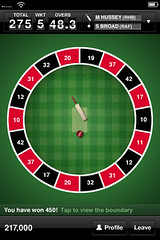 We launched an update to Roulette Cricket this week; lots of new features and a few tweaks. The previous version was pushed out in time for the IPCC matches and there were a few features we just didn't have time to squeeze in, which you can get now.
The big one you'll notice is commentary: you can now read a ball-by-ball account of the match on your iPhone, as it happens. One of the things I like about the app is that it's designed for partial attention - as a second screen whilst you're at work, listening to the radio or watching television. This means that accounting for the moments you'll miss is as important as showing you the game live. To that end we also let you replay the last boundary, so if you're distracted when it happens, you can see it again.
The other features are a bit less obvious; as well as the global leaderboard, which was rapidly filling up with players, we now have a per-game high score table. This means you still have a chance of getting fame and fortune on individual matches, if you can't follow all of them as some of our players clearly do :)
We also put in a few graphical twizzles and fixes, and a tweak around the display of times: where they used to be in GMT, they're now localised to your timezone. Cricket is an international game, pretending that everyone in the UK just didn't cut it.
There's more to come, of course - including one or two significant things we well know are missing. But this should keep you going :)
More launches
June 20, 2010 | Comments I've a little stack of launches which I've been meaning to blog about recently... things have been quite busy, hopefully I'll write more about that soon.
We've been working with the team at BBC Bitesize for a year or two now. Last year we worked on a suite of GCSE revision tools for conventional smart- and feature-phones, which took in a large amount of quiz-related content and churned out simple Java apps. They're quite straightforward: each app covers a single subject and contains a database of multiple choice questions organised by sub-topic.
We're quite comfortable with the technical and UI side of this sort of thing; the biggest problems were probably around the automation of builds (there are quite a few versions of the product for different subjects), and the inclusion of the quiz content: a quite large pool of questions, answers and imagery which needed to be folded, spindled and mutilated in various ways for different screen sizes.
 Early this year, the BBC came back to us and asked about taking the product onto more modern smartphones. With a relatively simple product, a limited budget, and a brief to go as far as possible on modern touch devices, this seemed like a good opportunity to see what we could deliver with HTML5. The work itself was fairly straightforward, and much of the original user interface didn't need to change significantly as we moved from keypad-and-menu to touch-based devices. We were also pleasantly surprised to discover how remarkably consistent browsers were between iPhone and Android, but see for yourself - the quizzes are all available here.
I'm also pleased that we managed to tie this work into the W3C Mobile Web Application Best Practices effort which I've been extremely tangentially involved in, by submitting an implementation report based on the project. If you're working on mobile web applications, I'd encourage you to do the same.