Tracking sleep with two different sensors
July 23, 2012 | CommentsI've been following the Quantified Self for a little while now, ever since Colin Hayhurst first mentioned them to me; and Kate has a similar enthusiasm for the quantitative, so we've both been tracking aspects of ourselves: between us weight (Withings), diet (manually), sleep (Zeo), and exercise (Runkeeper, Fitbit).
One of the modules of my Master's this year was Pervasive Computing, in which we spent a great deal of time looking at sensors and the real-world difficulties of extracting useful information from them. I did a project looking at LEDs, light sensors and morse code which I wrote about briefly here (and will post the full text of, once the course is over).
One key lesson from this was the difficulties of ensuring consistent useful results from different sensors; so when I noticed that Fitbit offers to track your sleep patterns, and Kate's Zeo did the same, I thought it'd be interesting to compare the results one gets from each. Fitbit straps to your wrist and detects hand movement, inferring sleep from a lack of such movement; Zeo monitors brain waves.
So a few nights ago I strapped both to myself and managed nonetheless to drift off. Here's what the Fitbit told me about my night:

Here's the Zeo for the same time period:
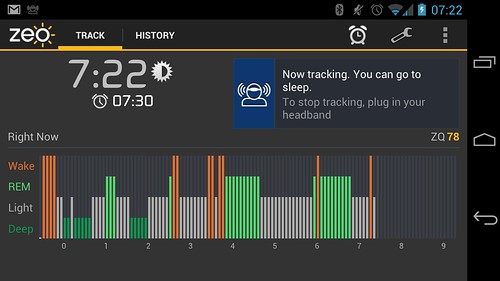
I was quite surprised at how close they both were. Here's the two graphs scaled to an equivalent size and superimposed:
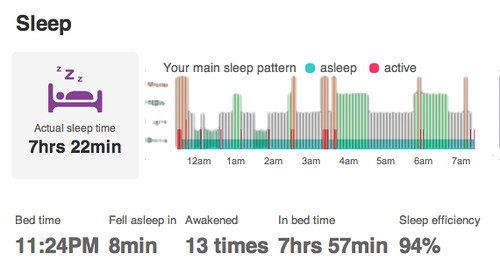
This seems to suggest that I'm twitching physically not just when I wake up, but when I move between different types of sleep…
As a result of this, I'm much more confident in both products, as they seem to be measuring something consistently using two completely different methods; which, funnily enough, is an approach which my course tutor Dan Chalmers covered in his pervasive computing textbook...
Guardian iPad figures
July 18, 2012 | CommentsThe Guardian have released figures for their iPad product - 17,000 iPad subscriptions, an unspecified number of Kindle ones.
I was trying to work out if this is good or bad. It's bad, because that's a small number (£2m gross revenue p.a. before Apple's cut). But with daily print sales of 211,511 in June, that makes iPad 7.5% of (print+iPad) readership.
I wonder how that compares to the percentage of Guardian readers who own iPads... my gut would be plenty of room for growth. I'm curious about those Kindle figures, which would reach a different audience... and I wonder whether there's any plan for a paid-for Android product?
Update: after a chat on Twitter with Benedict Evans: there are apparently 5.5m iPads in the UK, so iPad ownership here is 10%; not all those iPad subscribers are UK, of course, but it's a useful comparison. Not sure if we could conclude that iPad ownership in Guardian readers accords with that though, according to their own stats on readership their audience is roughly average in terms of age and gender, but skews towards being better educated and more likely to be AB than most. Accordingly I'd expect iPad ownership to be way higher - double? - for them.
Nexus 7 manufacturing costs
July 12, 2012 | CommentsiSuppli have reported on their teardown of the Nexus 7 - $152 BOM, if you hadn't seen it already.
Interesting to see how the Kindle Fire BOM has dropped from $191 to $139.80, in the 10 months since it launched. I'm not from a hardware background, but do manufacturers generally launch with the intention of making low margin on early adopters and compensating for that with mass market take-up once prices are lower? If so, given the buzz around decent low-cost tablets, one could consider this low initial margin to be advertising.
How long does a device like this continue to sell for - a year or more? If the Nexus 7 takes the same path, then even sales of the low-end version should be generating a reasonable profit in 6 months time, or leave room to drop the price further if Apple come in low with a rumoured/FUDding (delete as appropriate) smaller iPad.
I also wonder what the "additional costs" iSuppli talk about would include - shipping, packaging (or would the latter be "box contents")?
Carnival of the Mobilists
July 09, 2012 | CommentsHelen's hosting the latest Carnival of the Mobilists. I was please to note that it obviously costs more than $50 of Amazon vouchers to buy a good write-up from Terence Eden ;)
MSc Poster Presentations
July 06, 2012 | CommentsIf anyone's interested and around Sussex University campus next Friday, I'll be taking part on the Postgraduate Poster Presentations in two capacities: I'm still technically on the Informatics Industry Liaison Board, and I'll be participating as a student this year. Hopefully this will involve a double helping of sandwiches.