Future of Mobile: Tomi Ahonen
November 17, 2008 | Comments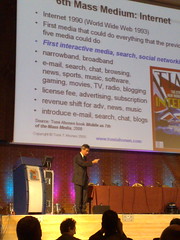 Future of Mobile: Tomi Ahonen
Mobile is as different from the internet as TV is different from radio.
All the concepts for TV we have today cannot migrate back to radio, though they did evolve from.
91% of mobile owners keep the phone within 3 feet, 24x7
Mobile is as addictive as smoking cigarettes. Removing mobile phones produces similar withdrawal pains as attempting to stop smoking.
Text-and-driving is more dangerous than stoned or drunk driving.
63% of people are not willing to share their phone with our spouse.
1 in 3 partners snoop inside the phone, mostly when we're in the shower. 10% of people ended relationships after this.
1 in 4 British couples sleeps apart 1 night a week because of their partners addiction to Blackberry, phones, etc.
Mass media are print, recordings, cinema, radio, television, internet, mobile.
What is print doing in a presentation with mobile? In Japan, mobile books sold ¢82m mobile books in 2006. 5/10 best-selling printed books started as mobile books. Books are written on phones using text-messaging, spelling and style.
The internet subsumed media that came before, and added interactivity. Look at Habbo Hotel for an example of a fixed internet service which raised revenue through mobile: by using billing.
Mice Love Rice: a song released for free on the internet. Sold as a ringback tone, raising $22m. Ringback tones have to be enabled by operators.
Don't try to copy the internet: create something new.
Mobile has seven advantages over internet: personal, permanently connected, always carried, built-in payment, present at creative impulse, most accurate audience, captures social context.
Carbon Diem: location-based service tracking how your mobile moves, discovering speed of movement and inferring carbon usage. Young people care more about green issues; for Tomi's generation WW3 was the threat.
Tohato: Japanese snack brand, introduced 2 new snack brands: Satan Jorquia and Habanero. Invited customers to choose a brand and fight the other brand in the "worlds worst war". Gamers joined by scanning a 2d barcode in a bag. Recruiting friends earned promotion in the army - all done via mobile, battles scheduled at 4am, with a 24-hour gaming news channel.
Hoshi-Ichi Maniac: mass participation TV format in Japan, Who Wants To Be A Millionaire, knock-out style quiz. 200k live players on the first run.
"Create services that are so amazing that the first time someone uses it, people think they're magic" - e.g. Kamera Jiten, a cameraphone translator which takes photos and translates them English to Japanese.
Future of Mobile: Rich Miner, Google
November 17, 2008 | Comments Future of Mobile: Rich Miner, Google
"Changing the mobile industry, one phone at a time"
Pre-iPhone, we saw the mobile industry as being closed. Unlimited data plans, browsing anywhere, installable apps... all moves towards openness, all difficult to reverse.
Every carrier in the US now has unlimited data plans: "carriers tend to behave like lemmings, when one starts in a particular direction the others follow behind"
iPhone pushed carriers to embrace someone else's brand on their network and be supportive of a model they couldn't directly monitise.
How bad could it have been? RM launched the first Windows Mobile SPV phone; didn't work that well, but showed promise. Orange was launching Push-To-Talk at the time, the SPV had a bug with PTT which MS were going to take 18 months to fix: derailing the launch. He worked for Orange Ventures, investing in applications and startups, but it still proved impossible for Orange to launch new products. Apps needed to be signed, tested, embedded. PMs of any threatened products derailed new ones.
The ability for consumers to connect directly to publishers (err... is it direct if it goes via Apple/G stores?) is a fix for this.
Mobile is the best distributed device, and in many cases the only connected device end-users own.
So it's important for Google. They found getting apps signed across many carriers troublesome. Constrained devices needed innovation to fix. Overall it was confusing to the developer and the end user.
As bill of materials cost for device falls, software has been a growing percentage of % of device cost: operating system, browser, codecs. There was no proprietary, open OS - and it felt bad for one entity to control any platform.
Simon from the Gears for Mobile team:
Lots of developers want to do quite simple things. On the desktop, between 2003 and 2006 there was a shift away from writing apps and towards mobile apps. GMail showed that the browser was capable of some interesting things. Google Maps showed nice draggable components.
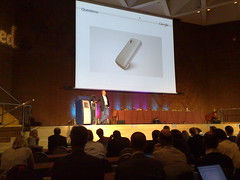 Mobile web apps suck for 3 reasons: latency in the network, poor access to local storage/caching, and lack of access to device capabilities (e.g. location).
Gears was originally designed for enabling offline web apps on the desktop. Today in the Android browser, you can deliver LBS apps.
End piece: "no one party controls the platform (nor a committee)".
Apps are self-published. No human makes a judgement on apps to go out.
Q: In open source projects, usability tends to get left behind. How are you going to guide the UI of Android?
A: Most of the phones we carry today aren't open source; this doesn't mean they have good interfaces. TiVo is built on open source with a good UI. Most of the web is built on open source.
Q: (Claire Boonstra) iPhone had greater hype than the iPhone when it first came along.
Q: Open technology, but will Google control it in any way. As a developer can I replace the search engine or maps application?
A: You can build a handset with no Google apps.
Q: (David Wood) How will you ensure the applications written by developers run on different handsets, when the platform has been modified by handset vendors?
A: Despite Java's best efforts, there wasn't a reference implementation to judge them by: this is the difference with Android. So the chances for fragmentation are lower. And we'll introduce a conformance test for OEMS, and encourage carriers to run it. In the early days of PC Clones, you had the "Lotus 1-2-3" test - if it ran this, the clone worked. We'll pick reference apps that challenge the platform in a good way, and educate people that these matter.
Interesting, a different argument from the one I've heard before (which was that fragmentation won't happen because "it's not in our interest") - much more detailed, much more useful.
Q: In the current implementation of Android, developers can't create their own home-screen widgets. Why?
A: The home-screen is just an app. We ran out of time to get a widget architecture in there. It's a common request
Future of Mobile: Panel Discussion
November 17, 2008 | Comments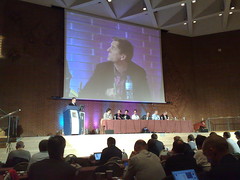 Future of Mobile: Panel Discussion
Panel discussion:
Dan Appelquist, Vodafone
Mark Curtis, Flirtomatic
Alfie Dennen, Moblog
Justin Davies, Twenty10
Carl Uminski, Trutap
James Body, Truphone
Sam, A.N.Operator
Q: Carl, where did you get your jacket?
A: !
Q: For application developers: where were we 2-3 years ago, what's changed, what's good, what's bad?
MC: You can advertise on mobile. There's a large audience to reach on the mobile, who weren't there 2 years ago. We ran our first ads on Admob in August 2006, saw an attractive cost of acquisition, but low volumes of users. Just after xmas 2006 we ran our first ads on operator portals and got 3.5k users in 3 hours - and they're good users, they spend money with us.
Q: And you Alfie?
AD: Advertising has made a difference, particularly if you don't have a relationship with an operator. Users aren't as afraid as they were of going off-portal.
Q: Justin/Carl, are applications still a dark art?
JD: J2ME lets you go quite a long way across the board in handset support. Java implementations are getting better but there are still problems. Applications now do work on handsets - a year ago VCs didn't like the idea of them, they preferred sites, but now people understand them better. Android, Apple have launched marketplaces and people are now used to them. From a UE point of view an app lets you do things a web site just can't do.
Q: How have emerging markets reacted, Carl?
CU: They're often not 3G users. We're finding customers with good connections and data rates, they're very cheap to use. We use optimised protocols to avoid bill shock. Also handset manufacturers and operators like applications.
Q: James, has the iPhone changed much for you?
JB: The App store has been a big success. We were the first VOIP app in the App Store, and did very well out of that.
AD: Doesn't it take us back a bit to have these closed, partitioned areas where commerce takes place? Won't discovery suffer?
JB: The Apple system isn't perfect but there's a fair chance an app will work if you get it through there.
Q: Will the application store model ever be mass market?
JD: It already is.
JB: We generate more revenue from iPhone users than Symbian users
DA: The App Store has also debunked the idea that real users don't want to use applications. The prevailing wisdom have been that applications were for the nerds.
JB: It's more about people not being told what they can buy by operators.
MC: It doesn't make much difference whether it's operators or Apple telling customers what they can download. It's more about how users will discover you, and thinking about how it'll happen in a years time once the fuss around the iPhone store has gone away. It's easy to get in the top 10 now, outside of that you're in the long tail - so where's the discovery then?
Q: Are you familiar with the UK operators and their developer services? Vodafone Betavine, O2 Litmus, Orange, T-Mobile.
DA: It's great to see O2 coming to the table. O2 Litmus is different from Betavine.
Q: Sam?
Sam: Operators have some value to add: identity, location, and billing. Location is being eroded because they didn't do anything with it. Identity is useful (through control of the SIM card). Revenue shares on billing are still very high.
Q: Do you use external agencies?
MC: Yes, but it depends what for. In the last 2 years, an external agency for usability - and it paid for itself twice over.
CU: We use Future Platforms :)
AD: Panelists doing applications: do you see a move towards web-based?
JB: It's going to be a mixture.
Q: How does a company approach Vodafone? Who sites the budget/acceptance of a third party app. How realistic is it for me to get my new application onto phones?
DA: The answer long-term is to use the web as a distribution medium. Vodafone is in a joint venture with China Mobile and Softbank Mobile. Q3 they're launching an app platform with these guys to upload widgets to a single store and have them distributed across all OpCos.
Q: With gaming generating more revenue than movies, why no mention of mobile gaming today?
JB: In the iPhone App store, lots of the popular apps are games.
AD: There's no-one from mobile gaming on the panel.
Q: For a mobile developer starting a new project today, iPhone or Android?
MC: Logically iPhone, cos it's out there and Android isn't.
AD: What he said, in part because it's hard to get onto any portal. If your business doesn't need a complex application, look at XHTML.
DA: You can do more with the web right now, on Android you can use Gears with web apps to get location/local storage. On iPhone you can use PhoneGap to do the same.
JB: We go for the platforms that generate revenue. Number 1 is Symbian, because "quantity has quality all of its own", 2 is iPhone because there are fewer but you generate more revenue. 3 is Blackberry.
CU: When you're looking at social networking, you need Java to get lots of platforms. iPhone and Android don't do J2ME. GetJar does good distribution through their store.
Q: Are iPhone users normobs?
JD: Apart from the people on this panel, yes. It's changed perception of what a mobile can do.
AD: Let's not forget it was broken in so many ways, but it was good at the basics. I don't have much time for it - it's taken us back a bit.
Q: What user numbers are mobile ad servers looking for to place ads?
MC: More than a thousand a day. Depends on whether it's on cost-per-click or CPM. CPM means 20-30k+ users a day before you make an impact. The off-portal market isn't expanding as fast in the UK as we would've liked to have seen. We're very dependent on advertising on operator decks. You need different techniques to milk a cow, a pig, a goat and a chicken.
CU: On location services, most people don't go to that many places: work, pub, gym, home. Because it's in a social context - it's useful. e.g. my friends know where I am if I'm at work.
Q: What's the best way to get new users? Bring them from the web to mobile, or direct to mobile?
JD: Get them on the mobile web, because you know they're already using the net on their phone. You can also filter by device.
Q: Will the most exciting apps come from Silicon Valley or Europe?
DA: India
MC: Europe
AD: Europe
CU: Europe
JB: Europe
Sam: Europe for Europeans, America for US
Q: Future of Mobile is...?
DA: The web
MC: Complexity
AD: One Web
JD: Personalisation
CU: Please cheap data
JB: Freedom
Sam: One web
Q: Android or iPhone?
DA: Android will be to the iPhone what the PC was to the Mac
AD: iPhone will learn from the web, it'll be an even playing field
JD: Android because it'll be on more handsets in emerging markets
CU: There's no comparison. It's Android or Symbian, iPhone is an end-to-end experience, Android is an OS.
JB: Today: iPhone. In 2-4 years, Android's looking good.
Sam: Android on an iPhone
Q: What's your favourite mobile app?
Sam: Twitter
JB: Mobile facebook
CU: Google maps
JD: Google maps
AD: GMail
MC: Google Maps
DA: Koi Pond
Future of Mobile: Doug Richard
November 17, 2008 | Comments Future of Mobile: Doug Richard
When you run software companies in the US, you divide companies into the US and Rest Of World (ROW). Trutap focused on the RROW (Rest of the Rest of the World).
Last year, a load of new users got their first mobile: 7m new people per month in India (that's one Finland per month). 130m new mobile subscribers worldwide last year.
Many of them think they're middle class: they have a purchasing power equated aspirationally to this. We're under the misimpression that the market is either a small wealthy market, or a huge number of third-world users.
It's not all farmers sharing crop prices.
So this is 500m+, disproportionately young consumers. They have fundamentally different quality of life in Mumbai to LA. Luke @ Trutap spent lots of time in India early this year, including dozens of interviews of current, prospective and failed Trutap users. They have the same needs as western kids have today with their iPhone or PC.
In the West, the PC is private; in Mumbai it's public - and data is more expensive in internet cafes than it is via mobile. Expressing yourself via the net becomes harder in these conditions.
In LA, internet usage is primarily PC. In Mumbai, it's mobile.
Needs and aspirations are the same between the two. I believe social networks are a temporary phenomenon on the PC: they belong on the phones. We want to keep up with friends and associates constantly, to meet others: this nirvana is in the offing. Nokia talk about the super-address book, but it's all the same thing. The new emerging middle classes are as large numerically as the whole of Facebook today: so social software isn't done and dusted, it's not all done yet.
Western operators will make conservative choices and adopt a defensive position - Indian operators will be more inclined to do risky stuff as they grow. All these things that people understand the mobile industry has to get over? They'll get over them first in India.
 Internal goal for Trutap 2.0: delivering an iPhone experience to everyone else. Can we do this? No - I don't own an operator, I have slightly less cash. But we can move in that direction.
The iPhone is having a disproportionate impact on the world: in emerging markets it's practically non-existent. But it shows what the future should be.
This will happen where there is capital, opportunity, and a large emerging middle class.
Trutap was a support of a web existence. We support all the worlds IM transports. Dating sites arose on the web independent of social networking; in Japan the two never split.
... shows off Trutap ...
We have an odd and unique time coming - the IT industry has been driven by the US, whilst mobile was driven from Europe. But we need to be sensitive to the fact that much innovation will come from emerging markets.
In a break from our regular programme...
November 11, 2008 | Comments ...I had a lovely weekend out, mostly spent catch up with Aikido folks in the south-east. On Saturday morning Mr Helsby and I took a train (and attendant rail replacement bus service) up to SOAS to train with Sue Smith and the Airenjuku London crowd, in the basement bunker which serves as their little shed.
Then the next morning 8 of us from Airenjuku Brighton drove over to Southampton to pay a visit to the Southampton University club - something we've been meaning to do ever since summer school in Chester this August. The Southampton guys made us feel very welcome, Alex Megann taught a fantastic class with Tom, and we sampled the delights of an indian buffet at Cafe Mumbai afterwards...
...driving back (or rather, being propelled half-asleep in my case: I was in the Land of Nod for the whole journey) just in time for our regular Sunday evening transmission.
Lovely, and not a mobile phone or laptop in sight ;)

And whilst I have your attention, take a look at these rather natty videos done by some aiki/tech lunatics with motion sensors and some interesting visualisation software: beautiful stuff.