LIFT 2008: Online Environments
February 07, 2008 | Comments LIFT 2008: Online Environments
First up, Bruce Sterling. "2008 is not going to be a pivotal year. It's a crap year."
"Even in the tech world, is it really exciting to watch Microsoft eat Yahoo!? It's an aging monopoly shoring up its position by feeding on the week. Microsoft is so boring Gates left - he'd rather cure malaria."
A phenomenon we will be confronted with in 2008: Carla Bruni! Sarkozy met her at a French tech summit, where DRM was discussed. Carla is an artist and a copyright owner. They are the product of an "internet policy romance".
[...Bruce rambles about them some more...]
"90% of success is showing up... surviving to see the future"
I found this one pretty disappointing, but I'm hoping it was intensely clever and I just didn't get it (wouldn't be the first time).
Next: Pierre, Bellanger, CEO Skyrock (French media group). "The social network: future of telecommunications".
Skyrock radio: 3.7m listeners/day, 13-24yo.
Skyrock.com: blog platform, 2nd largest French site when measured by page views. First French-speaking social network. 21m accounts, 13.5m blogs, >500m posts, >1.7b comments. 90% of users are French-speaking. Aspiration: to be the worlds social network for kids (quite contended, that one).
He just said "netamorphosis". And Christ wept.
"Social networks are for mail what search is for the web" - cute.
All electronic exchanges hang off digital identity. Social network profiles rather than names are being used for this. Profiles are apparently enriched by personal data!
"value is shifting from bandwidth to code"
"the code is tomorrow's social network"
"the mobile phone is rapidly evolving into a pocket-sized internet terminal"
"the terminal is always on and always with you"
"What's the bridge between social networks and mobile? It's certainly not trying to put a web page on a mobile phone: it's instant messaging."
They're going to merge instant messaging and social networks into a "social messenger".
He just said "Social Operating System", moving from actually making any sense through to "chucking technical terms into a talk to sound a bit 2.0" IMHO.
Now mobiles are apparently good for controlling PCs - they'll be used as terminals. Fantastic idea - simultaneously giving the PC an awful input device and tethering the mobile to a single location, killing its primary advantage OVER EVERYTHING ELSE.
"mobile cloud computing - each mobile device is a server, and maybe a phone"
I don't know, perhaps I'm being a bit cruel (and kudos to anyone who can present well in a language other than their native tongue - I can barely converse in English) but this was trite-tastic and chock full of buzzwords.
I'm quite close to the topic having worked on several large mobile social software projects over the last few years, but this talk seemed quite vapid to me, I didn't get anything new from this talk. I'd expect a LIFT audience to have gotten the idea that social networking and mobile might have been brought together or have some relationship that predates current social networking hysteria.
Next: Jonathan Cabiria on Permeability: Real Life + Virtual Life = One Life
Psychologist, spent the last year looking at how participation in virtual worlds affects real life.
"The self is not something that one finds - it is something that one creates" - Thomas Szasz
We have many different identities (conscious and unconsciously) - evolutionarily speaking, for survival. If we present others with a facet of our identity they don't like, we get marginalised. If we don't fit in, we over-assert our identity ("fuck you, this is who I am"), or repress (cloak ourselves with an identity affect of the society to which they wish to belong) and hide.
Suppressing identities has severe psychological effects ("living an inauthentic life"). Virtual communities can assist here: finding a community of similar others affected self-esteem and translated back into the real world.
In our language we divide the real and virtual; but to some it's not real life or second life, it's all one life.
What does this mean for developers of social environments? We're always looking for ways to solidify our place in society.
Interesting talk, I wish it had been a bit longer and he'd gone into some recommendations for developers....
Next, Stephanie Booth: "Going solo, being a freelancer in a connected world".
2 years ago she was a middle-school teacher, left work. At first "people paid me for things that didn't feel like work". Started thinking about pricing, hired accountant. Realised she wasn't that great at negotiation. Trick to set day rates: work out monthly income desired, divide by number of days you will actually work. People don't pay for time, they pay for expertise. She's organising a conference for freelancers.
Can I write "sweet" without sounding patronising? Probably not. Shame.
Now Ewan McIntosh: "How social media creates social education"
Another former teacher. Works with Scottish govt on social media. Shows this video - notice lack of reaction from her mother in the background, who clearly doesn't care her daughter is breaking the world record :)
What makes good schools? Good teachers.
They started out with 20 teachers sharing their classroiom experiences, within a few months they had 350. They now have 1300 students and teachers blogging. They have kids doing video, podcasting, filmmaking, too. The community even created safety guidelines together (on a wiki?).
In 19th century, average audience for childrens work was 1 person. It's still the same - the teacher - despite advances elsewhere.
LIFT 2008: A glimpse of Asia
February 07, 2008 | Comments First up, Mark Laperrouza of EPFL on the current state and latest trends in Chinese telecomms. He's started a non-profit micro-credit fund for students, Bono Pro.
3 major blocks of economics are traditionally Europe, Japan and USA. In fact the two major economies are China and India. Japan and Europe are shrinking populations (I may have misheard this...).
Three basic messages:
- Mobile technology is the first technology to be used more in the developing world than the developed world;
- The war for telecomms standards will be waged in Asia;
- Mobile phones mean radically different things to different people;
Mobile has leapfrogged fixed-line communications. 25% of growth in the last 12 months was in China and India. Mobile is going to be the primary means of Internet access, even for illiterate users. Myanmar: 1% mobile penetration, Hong Kong: 101%. There's massive discrepancies across Asia.
In the US ARPU is $40 average; in China it's $11.
3 of the largest 5 mobile operators are in Asia. China Mobile: 350m customers. Second Vodafone: 200m.
China Mobile set up a mobile network at the Mount Everest base camp! They get 5-6m new customers pcm, 1m are new contracts, 4-5m are PAYG. Estimated 50-100m mobile internet users pcm. Location-based-services launching soon -is there more or less of a privacy issue in China than in more open democracies?
This implies a vast number of handsets, which implies an ecological issue. Nokia etc responded by setting up recycling bins, but as it happens the Chinese are happy to recycle/resell so these aren't getting used so much.
Most people in the developing world never roam more than 90km from where they're born. In developing countries relatively obsolete technologies can still be useful.
The Chinese developed their own 3G standard, TD-SCDMA, to avoid paying royalties to Qualcomm etc. Existing operators don't want this government-imposed standard and Chinese handset manufacturers want to sell their handsets to the rest of the world - so they've favoured 3G and GSM. There are some doubts over whether China will have 3G in time for the Olympic games, thanks to technonationalism. In China and Korea there's strong state involvement with technology.
Shows off: first "feng shui" phone which senses your environment. First mobile with inbuilt cigarette holder. First iphone knock-off, released in China before iPhone was launched.
What are the differences between Chinese and Western mobile usage? Difficult question. Instant messaging is a biggie: they're relatively impatient for responses. In China, it's acceptable to answer telephones during meetings, say.
Bangladesh and Grameen phone: it's microtrading for phones. Most people don't have access to market price information thanks to lack of communication and illiteracy. Knowing pricing can be important in business.
The future of China's economic development, the big task, is raising the level of living standards in the countryside, not the cities - and this is what will make or break "the Chinese miracle".
Two quotes from Wang Janzhou, Chairman China Mobile:
"If someone doesn't have a mobile phone they will lack the basic functions of what it is to be human"
"We know who you are and where you are"
 Next speaker, Heewon Kim of Seoul University on youth and social software:
Stats on Korean environment:
- 30m broadband subscribers, 26% of population (or nearly every household).
- 38m mobile subscribers, 43% use it for mobile internet.
- 7.2Mbps connections to mobile via HSDPA
Internet culture in Korea is led by appearance of the individual. Cyworld quoted as a good example.
Minihompy: personal home pages. Sometimes used to present candid photos, sometimes they are edited/touched up first (often this is what drives users to learn about photo editing software).
Beyond self-expression, self-branding: an archive of everyday life, diaries, and thoughts.
Real-time intimacy is enabled by real-time comms. It doesn't need to be synchronous, almost-synchronous is fine.
Cyworld got really popular in 2003. It's still mainly teenagers, 20somethings are staring to leave.
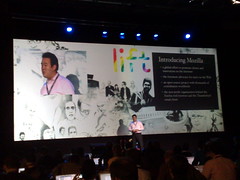 Now Gen Kanai, who does biz dev for Mozilla Japan, talking about OSS in Asia:
28% market share in Europe.
2% market share in China (3.5m users).
10-12% market share in Japan.
Korean market restricted by encryption protocols. But also it was so far ahead of the world in broadband that crypto standards weren't available worldwide (?), so the Korean government went their own way. As of today, IE is the only way to do crypto in Korea - Microsoft have a de facto monopoly.
There's a tendency for Asians not to contribute to open source: thanks to culture, language and education, according to Linus Torvalds, no-one really understands why.
Take Bhutan (no, really!): 2.2m population, very isolated. In top 10% of happiest nations, Gross National Happiness more important than GNP. Microsoft wouldn't do them a Bhutan language OS, so they went to open source. Very interesting - they now have an opportunity to control their future and their language. They built the OS on top of Debian in just over a year for about $80k cost.
Ruby was developed by a Japanese developer.
In the West there's often a lot of direct confrontation in OSS projects. This type of dialogue is less common in Asia, both in person and online. Some of the standards by which people interact aren't there.
Language is an issue; it's not just a question of writing in code, it's about communication around the code too.
OSS has traditionally depending on a certain level of economic development: developers having time outside of work to carry out pro bono programming.
Another cultural difference: the west succeeds on meritocracy. This isn't necessarily true in Asia. Free and freedom are key ideals of open source, but the terms may have been polluted by international politics of late.
Physical/digital car crash
February 06, 2008 | CommentsI'm Bluetoothing some files from my phone to my laptop. My phone is sitting on the desk to the right of my laptop. I just caught myself absentmindedly moving the "Bluetooth transfer" window over to the right-hand side of my screen, so it would be nearer to my phone and help the photos transfer across quicker...
It's nice to see instinctual stuff intrude on decades of intellectual conditioning sometimes :)
LIFT 2008: Upgrade your company - Industrial opportunities for the internet of things
February 06, 2008 | CommentsUpgrade your company - Industrial opportunities for the internet of things, Vlad Trifa
(I arrived 15 minutes later, after the presentation)
Growth in open source sensor technologies. SAPs NetWeaver is an open source set of tech for this. Interop is important - companies want open standards.
[ Break-out session on threats and opportunities of embedded sensor networks ]
Now classifying thinking from the various groups into technological, social, interaction design and business aspects: T, S, I, B
Group 1:
- Do we let computers decide? (S)
- Do I trust these systems? (S)
- How do we know we're safe from hackers either controlling or reading sensors? (T, S)
- How do we ensure data is encrypted or safe? Should it expire so that by the time it can be encrypted, it's worthless? (T)
- Is it healthy? (S)
- How do you route traffic in a large network? (T)
- Can we share network information freely and share it (e.g. Swiss train timetables and train positions)? (I)
- Can we create our own on-the-fly networks? (I)
- How do we present a "CPU-based-solution"? (T)
- What do we want? (B)
Group 2:
- Technology is neutral, use of technology is where opportunity/risk lies. (S)
- Lots of opportunities for company appliances. (S)
- How do we define access to data or limits of privacy? (S)
- What happens at the end of these devices' life? What's their life cycle and ecological impact? (S)
- Energy issues, energy scavenging from whatever you monitor (e.g. measure vibrations and simultaneously extract energy from them). (T)
- Challenge of integration: will human beings accept this sort of thing on a large scale? What happens to people who don't accept it? (S)
- Customers are looking for differentiation, but much of this technology is a commodity and everywhere - which doesn't bring that. (B)
- Legally and in terms of privacy, we're lagging behind the technology. (S)
- There's no standardisation of this stuff yet when it comes to RFID (and wireless or even power). (S)
- Singapore is interesting: they've integrated some of these technologies and can monitor a great deal about their citizens. (S)
- Maybe these technologies could be used for selective terrorism - e.g. use RFID readers to recognise individual Americans and therefore target individuals. (S)
Group 3:
- How do we design for failure, for networks of sensors which have a finite life and depend on each other? (T)
- The classic science-fiction vision of the future is seamless, with technology mediating everyday life. How might we use sensor networks to bring back serendipity? (S)
- Digital sensors digitise everything, quantising analogue data. Does access to digital sensors reduce our confidence in the analogue (biological) ones? (I)
- Measuring something changes our relationship to it - e.g. Nike+ changes my running habits. (I)
- Younger generations may have a different relationship with this technology to us. We consider our homes to be what lies within 4 walls, when wireless networks extend our reach beyond these confined areas - an extension younger generations may unconsciously factor in. (Channelling Dunne & Raby here) (S)
- Ethical debate: we embed chips into cats and dogs, when do we start routinely doing this to humans? (S)
- Visibility: the dilemma of control over being controlled. (S)
Vlad talks about a "city of the future" being funded and built from scratch in Korea, which will be fully digital: no money, keys, etc: "New Songdo City". Also brings up the example of Octopus in Korea (must find out more about this).
Question from the audience: is there another model of exchange beyond bits and bytes of privacy exchanged for a smoother passage through life?
(Would this data have value if anonymised and then aggregated? Would this provide a means of playing with these sort of networks (which we don't fully understand) in society (which we don't fully understand) more safely? So, for instance: the room I'm in right now has 14 or so people in it. The fact that there are 14 people here probably enables us to make some sensible decisions around air conditioning, temperature, and lighting - without us knowing anything about who these people are. So would a sensor network which only provides information consumers with anonymised information be of any value?)
Q: how do we cope with different desires from different individuals? If I walk into a room and tell the window to open, then my dad walks in and asks it to close - who wins? How do we achieve consensus with these technologies as we do in a democratic way in our society?
LIFT 2008: Ubiquitous Computing: visions, failures and new interaction rituals
February 06, 2008 | Comments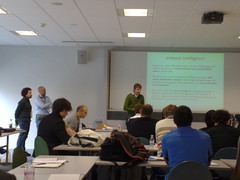 LIFT 2008: Ubiquitous Computing: visions, failures and new interaction rituals
A special treat, this one: Nicolas Nova, Fabien Girardin & Julian Bleecker.
Intro from Nicolas. Handover to Fabien.
Definition of ubicomp: dissemination and deployment of sensors, information processing, wireless communication in everyday objects and the environment: RFID, Nabaztag, Wi-fi in the home, GPS navigation systems.
Early vision: "The most profound technologies are those that disappear" - Mark Weiser
This evolved into calm technologies: things that "remain in the background and allow users to interact in a calm, engaged manner".
Philips' vision of ambient intelligence: relating to electronics in a more natural and comfortable way, making electronics smart.
Julian: inserting technology into everyday objects (e.g. a baby's pram) runs the risk of overengineering and ignoring social practices.
Failures: recurring crashes, lack of adoption from users, uncertainty, complication practices. Why? Product doesn't match expectations, bad design, poor product vision ("technooptimism"), poor integration into the value chain. It's difficult to differentiate between failure and its reasons.
Activity: write down an example of a tool/tech failure and 1-2 reasons for this situation. I chose 3G video calls (failed because there wasn't much demand and they complicate communication IMHO, rather than making it more lifelike).
Divide into groups: take 3 postits, discuss the idea, reasons for failure, capture these, describe consqeuences.
First group: discussing the ticket machines for the Geneva bus system. Lovely example of appalling design, multiple mis-labelled duplicated areas, horrendous pricing model, etc.
[...snip...]
Random quote: "ubicomp should be helping us make a choice, not replacing us".
Next group: electronic book reader. Cons of ebook readers: lack of content, expensive readers, resolution wasn't sufficient enough to make reading enjoyable. There's a big assumption of user behaviour, that the value added by moving to e-books outweighed the inconvenience of carrying your book everywhere. The value of digital content wasn't necessarily the same as the value of digital content. BUT recently there's been a generational shift towards consuming digital content; individuals now have different expectations towards digital media. Kindle is chunky, but will the future be a single device for reading? Or will any device with a screen gravitate towards e-book reading?
Banking is an example where the user normally has no control until an extreme event (fraud detected) occurs.